

Collagen has become one of the most popular supplements of the last decade, driven by promises of younger skin, smoother joints, shinier hair, stronger nails, and even improved gut health. In 2025, the global collagen market is larger than ever, with hundreds of powders, peptides, liquid shots, fortified coffees, and “beauty blends” flooding online stores.
But how much of the collagen hype is supported by real science?
And more importantly: which forms of collagen actually work for skin and joints?
To answer this, the NutraPro Research Team analyzed more than 40 peer-reviewed studies, compared over 60 collagen supplements, and examined the most credible evidence available. This guide summarizes what truly matters.
What Collagen Actually Is
Collagen is the body’s most abundant structural protein. It gives skin its firmness, supports cartilage, strengthens ligaments and tendons, and provides the internal “scaffolding” that holds tissues together.
After the age of 25, natural collagen production declines at a rate of about 1 to 1.5 percent per year. Sun exposure, stress, inflammation, and poor diet accelerate the decline. This is why people experience early wrinkles, joint stiffness, slower recovery, and loss of skin elasticity as they age.
Supplementing with collagen theoretically helps by providing amino acids needed for rebuilding connective tissues and by triggering collagen-producing cells through specific peptides.
Types of Collagen and Why They Matter
There are more than 20 collagen types in the body, but only three are essential for supplementation:
Type I
Found in skin, hair, nails, and bones. Best for beauty and anti-aging.
Type II
Found in cartilage and joints. Best for joint pain, flexibility, and cushioning.
Type III
Found alongside Type I. Supports skin elasticity and gut lining repair.
Most collagen supplements on the market are rich in Type I and Type III, which makes them suitable for skin health. Only a few are specialized in Type II for joint support.
Understanding this distinction is crucial when choosing the right product.
Hydrolyzed Collagen vs. Collagen Peptides
Hydrolyzed collagen and collagen peptides are essentially the same thing. Both forms have been broken down into smaller fragments that are easier for the body to absorb.
Studies show that hydrolyzed collagen:
- is absorbed efficiently
- reaches the bloodstream in measurable peptide form
- triggers fibroblasts (collagen-producing cells)
- improves skin hydration and elasticity
- supports cartilage regeneration
This is the form you want in supplements.
Gelatin is simply a less processed version of collagen and is less bioavailable.
Marine Collagen vs. Bovine Collagen
Marine collagen is made from fish skin and scales. It is rich in Type I collagen and has a smaller molecular size, which improves absorption. It is preferred for skin, hair, and anti-aging.
Bovine collagen is made from cows and contains Type I and Type III. It is effective for both skin and general wellness.
For joint support, a different form is required: undenatured Type II collagen, usually derived from chicken cartilage.
Proven Benefits of Collagen (According to Studies)
The strongest evidence for collagen supplementation is in two areas:
Skin Health
Studies consistently show:
- increased hydration
- improved elasticity
- reduction in fine lines
- better firmness
Collagen peptides appear to stimulate fibroblasts, leading to measurable improvements after 8 to 12 weeks.
Joint Health
Clinical studies on Type II collagen show:
- reduced joint discomfort
- improved mobility
- decreased inflammation markers
- benefits for athletes and older adults
It is not a painkiller. It works gradually by supporting cartilage regeneration.
Hair and Nails
Evidence is weaker, but many users report reduced nail breakage and slight hair thickness improvement due to increased amino acid availability.
Gut Health
Collagen may help reinforce intestinal lining integrity, but evidence is still emerging.

What Collagen Does Not Do
Despite exaggerated marketing claims, collagen does not:
- cause dramatic weight loss
- replace sunscreen
- erase deep wrinkles
- provide instant joint relief
- significantly increase muscle mass
It is supportive, not miraculous.
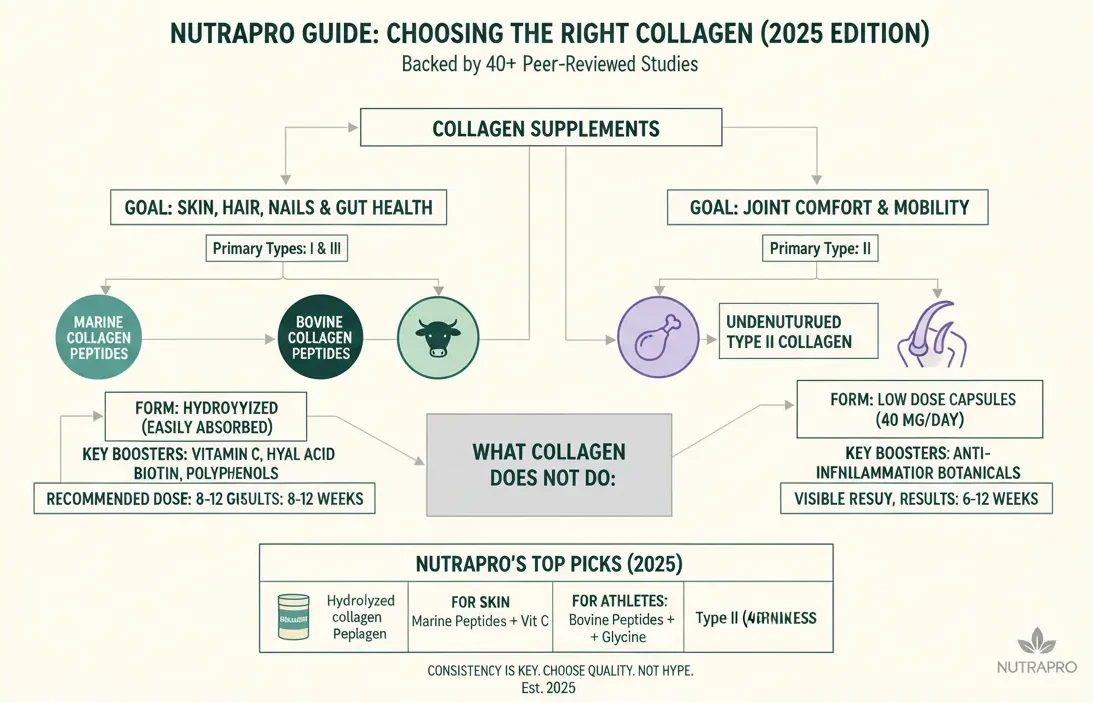
The Best Forms of Collagen for Each Goal
For skin and anti-aging
Marine collagen peptides or high-quality bovine peptides (Type I + III).
For joints
Undenatured Type II collagen, even in low doses (40 mg daily).
For recovery and active lifestyle
Bovine peptides combined with vitamin C and glycine.
For general beauty routines
Hydrolyzed collagen powders, ideally 10 g daily.
Ingredients That Boost Collagen’s Effectiveness
Studies show that certain nutrients synergize with collagen.
Vitamin C
Required for collagen synthesis and cross-linking.
Hyaluronic Acid
Enhances hydration and skin plumpness.
Silica and Biotin
Support skin and nail structure.
L-Lysine
Essential amino acid for collagen building.
Polyphenols
Protect collagen from oxidative damage.
Supplements containing these ingredients tend to produce better results.
Collagen Loading: Does It Work?
Some influencers recommend very high doses in the first weeks. Research does not support this. Benefits come from consistency, not megadosing.
The optimal long-term dose for beauty and skin health is 8 to 12 grams per day. For joints, undenatured Type II collagen works at much lower doses.
How Long Until Results Appear?
Skin improvements
8 to 12 weeks
Joint mobility
6 to 12 weeks
Hair and nails
8 to 16 weeks
Gut support
4 to 8 weeks
Consistency is essential.
Collagen Powders vs. Capsules vs. Liquids
Powders
Most cost-effective and easiest to dose.
Capsules
Convenient but often underdosed.
Liquids
Absorb well but typically contain additives.
Single-ingredient hydrolyzed powders provide the highest purity.
Collagen Myths to Ignore
Myth: Collagen cannot be absorbed
Reality: Hydrolyzed peptides are found in the bloodstream after consumption.
Myth: Vegan collagen is equivalent
Reality: True collagen cannot be vegan. Vegan products are precursors, not collagen.
Myth: More grams equal better results
Reality: There is a threshold of benefit. More is not necessarily better.
How to Choose a High-Quality Collagen
A good collagen supplement should have:
- hydrolyzed collagen peptides
- transparent sourcing
- third-party testing
- no artificial flavors or sugars
- minimal additives
- clear type specification (I, II, III)
Avoid low-grade gelatin-based powders or proprietary blends with undisclosed concentrations.
The NutraPro Collagen Recommendations for 2025
For skin quality
Marine collagen peptides with vitamin C and hyaluronic acid.
For joints
Undenatured Type II collagen (40 mg) plus anti-inflammatory botanicals.
For athletes
Bovine collagen peptides combined with glycine and electrolytes.
For general wellness
High-purity hydrolyzed collagen powder with no fillers.
Final Verdict
Collagen is not a miracle supplement, but it is one of the most reliable and well-studied options for improving skin elasticity, hydration, and joint comfort. When used consistently, the results are measurable and meaningful. The key is choosing the right type of collagen for your goal and sticking with it long enough to see the benefits.